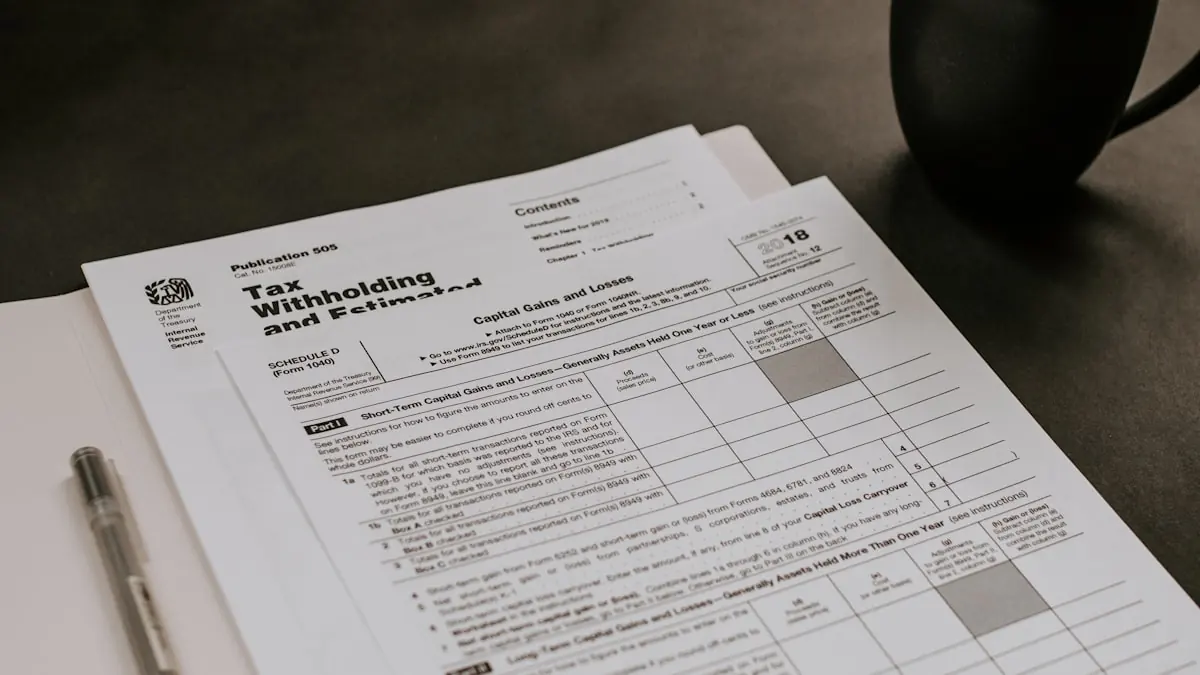
Every April, business owners walk into our Media office with their year-end profit and loss statements hoping for a miracle deduction.
They want to know what can be done to lower their tax bill before the filing deadline.
The honest answer is almost nothing.
Tax preparation is an exercise in historical recordkeeping that simply reports what already took place during the prior twelve months.
Tax planning is the proactive financial engineering that occurs while the year is still open and you still have time to move cash, restructure compensation, and buy assets.
On a profitable business, the difference between those two approaches is usually measured in thousands of dollars, and sometimes a great deal more.
Timing is everything.
The fundamental divide between reporting history and changing outcomes
If you wait until spring to think about your business taxes, you are essentially driving your company by looking exclusively in the rearview mirror.
Tax Preparation (Spring)
Documents transactions that are already locked. Strictly compliance-driven with zero ability to alter gross revenue or prior expenses.
Tax Planning (Q3 & Q4)
Restructures capital purchases, payroll salaries, and retirement plan designs before December 31 to legally minimize taxable net income.
When you execute smart tax moves in October or November, you take control of your numbers instead of reacting to an unexpected tax bill five months later.
And Delaware County businesses have substantial tax code mechanisms available to them if they act before midnight on December 31.
Let us examine the highest-yield moves.
Section 179 expensing and the bonus depreciation phase-down
Under Section 179 of the Internal Revenue Code, your business can immediately deduct the full purchase price of qualifying equipment, machinery, technology hardware, and business vehicles placed in service during the tax year.
That allows you to write off the entire cost in year one rather than slowly depreciating the asset over five or seven years.
- Section 179 limit: Up to $2,560,000 of qualifying equipment can be expensed dollar-for-dollar in year one for 2026, with the deduction phasing out once purchases exceed $4,090,000.
- Bonus depreciation restored: The One Big Beautiful Bill Act permanently reinstated 100 percent first-year bonus depreciation for qualified property acquired and placed in service after January 19, 2025, repealing the previous phase-down schedule.
- The placed-in-service rule: The asset must be fully delivered, installed, and operational by December 31, not just ordered online.
If an HVAC contractor in Springfield or a dental practice in Broomall orders fifty thousand dollars of new equipment on December 28, but the shipping crate sits unopened in the parking lot until January 4, you lose that entire deduction for the current tax year.
So plan your capital purchases in early Q4 and give your vendors room to deliver and install before the year closes.
Do not risk delivery delays.
S-Corporation reasonable salary optimization
If you operate an LLC taxed as an S-Corporation, your total net earnings are divided into two distinct buckets: your W-2 wage and your shareholder distribution.
Every dollar you pay yourself as W-2 wages is hit with 15.3 percent in combined Social Security and Medicare taxes, plus an additional 0.9 percent Medicare surtax once your earnings cross high-income thresholds.
Shareholder distributions, by contrast, pass through to your personal return completely exempt from self-employment taxes.
Balancing your reasonable W-2 salary against your S-Corp distributions is the single most reliable recurring tax-saving mechanism available to small business owners.
If your business generates two hundred thousand dollars in net profit and you take the entire amount as a sole proprietor distribution, you pay full self-employment tax on all of it.
If you structure that same business as an S-Corporation with an eighty-thousand-dollar reasonable salary and a one-hundred-twenty-thousand-dollar distribution, you save approximately fourteen to fifteen thousand dollars in payroll and self-employment taxes in a single calendar year.
But you must defend your salary choice with empirical wage data from your specific industry and region.
The IRS routinely challenges arbitrary, artificially low salaries that lack documented market justification.
We document the wage data behind a salary figure while the year is still open, so the justification exists before anyone asks for it.

High-capacity retirement plans beyond standard IRAs
Are you still contributing just seventy-five hundred dollars to a traditional IRA each year?
For a highly profitable business owner, relying on standard consumer retirement accounts leaves the largest tax deduction in the entire Internal Revenue Code completely unused.
- Solo 401(k): Allows an owner-operator to contribute up to $24,500 as an employee elective deferral for 2026, plus up to 25 percent of W-2 compensation as an employer profit-sharing contribution, sheltering up to $72,000 per year before catch-up contributions.
- Defined Benefit / Cash Balance Pension: Enables business owners with high free cash flow (particularly those aged 40 and older) to make tax-deductible contributions exceeding $150,000 to $250,000+ annually.
For an owner with the age profile and the free cash flow to support it, pairing a cash balance plan with an existing 401(k) can move a six-figure amount of top-bracket income off the current year. An actuary sets the contribution against your age and compensation, so the number is specific to you.
Plus, those assets grow completely tax-deferred inside protected trust accounts until retirement.
Under SECURE Act 2.0 rules, you have additional flexibility to establish certain employer-funded retirement plans up to your tax filing deadline, but your employee elective deferral elections must be formally executed before December 31.
Do not let that deadline slip past you.
The SALT deduction, and the Pennsylvania workaround that does not exist
You have probably read that pass-through owners can sidestep the federal cap on state and local tax deductions by having the business pay the state tax at the entity level.
That election is real in most states. It is not available in Pennsylvania.
Pennsylvania is one of the last states with a meaningful income tax that has never enacted a pass-through entity tax. Bills have been introduced in Harrisburg more than once and none has become law, so there is no Pennsylvania entity-level election to make on your PA-40 or your Form 1120-S.
Be careful with advice that says otherwise. It is usually written for New Jersey or New York and copied across state lines.
- The federal cap is $40,400 for 2026, not $10,000. The One Big Beautiful Bill Act raised it to $40,000 for 2025 and it rises 1 percent a year through 2029.
- It phases down above $505,000 of modified adjusted gross income in 2026, cut by 30 percent of the excess, but never below $10,000.
- It is temporary. The higher cap is scheduled to expire after 2029 and revert to $10,000 unless Congress acts again.
So your Pennsylvania 3.07 percent income tax and your local Earned Income Tax still land on your personal return, where the cap applies.
The lever you are left with is timing. If your deductible state and local tax is running under the cap, paying a fourth-quarter estimate in December rather than January pulls the deduction into the current year. If you are already over the cap, that same payment buys you nothing federally, and the cash is better used somewhere else.
One exception is worth checking. If you hold an interest in a pass-through that operates in a state that does offer the election, that state's entity-level tax can still be worth modeling on the out-of-state share of your income.
Know which state you are actually in.
Local Delaware County tax considerations and timing strategies
Federal tax brackets are only part of the equation when you operate a business in southeastern Pennsylvania.
Pennsylvania levies a flat 3.07 percent personal income tax on net profits, with no standard deduction allowed.
Furthermore, local municipalities across Delaware County (such as Media Borough, Upper Providence, Marple, Haverford, and Radnor) enforce local Earned Income Taxes (EIT) under Act 32 that typically add another 1.0 to 1.5 percent to your earned income burden.
- Accelerate deductible expenses by prepaying annual software subscriptions, commercial insurance premiums, and professional memberships in late December.
- Hold late-December client invoices until the first week of January to push cash collections and revenue recognition into the following tax year if you use cash-basis accounting.
By strategically timing when revenue arrives and when expenses are paid during the final thirty days of the year, you can smooth out your annual income spikes and prevent unnecessary bracket creep.
It gives you immediate breathing room.
Your four-point Q4 tax planning checklist
What concrete steps should you take right now?
Start by scheduling a mock tax calculation in October or November based on your actual nine-month profit and loss numbers so you have a realistic forecast of your impending tax liability.
Next, review your capital expenditure plans and ensure all qualifying equipment is placed in active service before December 31.
Then verify that your S-Corporation shareholder compensation reflects justifiable wage data while maximizing distribution efficiency.
- Run a Q3/Q4 mock tax return with your CPA to identify projected taxable income.
- Place all Section 179 qualifying equipment in service before December 31.
- Execute annual S-Corp wage studies and finalize year-end payroll adjustments.
- Check where you land against the 2026 SALT cap before you time state and local payments.
- Establish custom high-capacity retirement plan contributions before year-end deadlines.
When you shift your mindset from reactive spring tax prep to proactive autumn tax engineering, you stop overpaying the government and keep significantly more hard-earned cash inside your business.
Start planning before the year closes.
Take control today.
Professional Tax & Legal Notice
The information contained in this article is provided for general educational and informational purposes only and does not constitute formal tax, legal, financial, or accounting advice. Federal, state, and local tax laws are complex, subject to change, and applied based on specific individual and business facts and circumstances. Reading this content does not establish a CPA-client or fiduciary relationship with Gemini Accounting Services LLC. Readers should consult with a licensed Certified Public Accountant (CPA) or qualified tax attorney before making tax elections or taking financial action.